
The HVAC industry seems to have its own language, with terms like “SEER rating,” “MERV rating,” “plenum,” and “condenser coils.” Because of this, it never surprises us when a homeowner calls and asks about their air conditioning system’s Freon. It’s a term that has been around for decades and has become synonymous with AC cooling.
However, it’s important to clarify that Freon is actually a brand name for a specific type of refrigerant that has been phased out due to its harmful effects on the ozone layer. So, when most people want to know if their AC needs more Freon, what they’re really asking about is their system’s refrigerant levels. Refrigerant is a chemical compound used in a heat pump or air conditioner to absorb heat from the indoor air and release it outside, thereby cooling your home. The reason people want to know if their AC needs more refrigerant is usually because the unit isn’t cooling the home properly. After all, a lack of cool air is one of the most common signs of low refrigerant.
Regardless of whether you call it Freon or refrigerant, we’re here to explain when (and if) an AC system needs a refrigerant recharge. The answer might surprise you.
How Often Does Your AC Need Freon?
As we mentioned, Freon is a brand name for a refrigerant, specifically R-22, which was once the standard in residential air conditioning systems. However, due to the 1987 Montreal Protocol, an international treaty designed to protect the ozone layer, the production and import of R-22 have been phased out in the United States. As of January 1, 2020, R-22 can no longer be produced or imported.
What does this mean for you as a homeowner? If your air conditioning system was manufactured before 2010, it likely uses R-22. While it’s not illegal to continue using an R-22 system, any remaining supply of this refrigerant is now extremely limited and, as a result, very expensive. If your older system develops a refrigerant leak, the cost of recharging it with R-22 can be substantial. In many cases, it makes more financial sense to replace the entire unit with a newer, more efficient model that uses a modern, environmentally friendly refrigerant like R-410A or the newer R-454B (for ducted systems) and R-32 (for ductless systems).
So, to answer the question directly: your AC will never need Freon again in the sense of the old R-22. If you have a newer system, it doesn’t use Freon at all, so it will never need more Freon. If you have an older system, topping it off with reclaimed R-22 is a costly, short-term fix that doesn’t address the underlying problem, which is almost always a leak.
How Often Does Your Home’s AC System Need Charging With Refrigerant?
Now, this brings us to the question, how often does your air conditioner need to be recharged with refrigerant, regardless of the type? The simple and most accurate answer is: never.
This is a point that often surprises homeowners. Many people think of refrigerant like gasoline in a car — something that gets used up over time and needs to be refilled periodically. This is a fundamental misunderstanding of how an air conditioning system works.
Your AC is a closed-loop (or sealed) system, and the refrigerant is not a fuel source; it’s a heat transfer agent. It continuously circulates through a series of coils and a compressor, changing from a liquid to a gas and back again. In a properly functioning, leak-free system, the amount of refrigerant you have on day one should be the same amount you have ten years later. It doesn’t dissipate, evaporate, or get consumed during the cooling process.
Therefore, if you find that your system is low on refrigerant, it is not because it was “used up.” It is because there is a leak somewhere in the system. Adding more refrigerant without finding and fixing the leak is like continuously pumping air into a tire with a nail in it. It might work for a little while, but it doesn’t solve the problem, and you’ll be right back where you started sooner rather than later.
How a Refrigerant Leak in Your AC System Should Be Handled
If a qualified HVAC technician inspects your system and determines that it is low on refrigerant, simply “topping off” or “recharging” the system is not the proper course of action. Here’s what the proper process should look like:
- Find the Leak: Refrigerant leaks can be notoriously difficult to pinpoint. They often occur in the evaporator coil (the indoor unit), the condenser coil (the outdoor unit), or the copper lines that connect them. Leaks can be microscopic, and technicians use several methods to find them, including electronic leak detectors and nitrogen pressurization tests. This is a specialized process that requires professional equipment and expertise.
- Repair or Replace the Leaking Component: Once the leak is located, the next decision is whether to repair or replace the faulty part. If the leak is in an accessible location, such as a joint or a valve, it can often be repaired. Unfortunately, refrigerant leaks often occur in the coils themselves. The evaporator and condenser coils are made up of hundreds of feet of thin tubing with fins attached. A leak in the middle of a coil is often impossible to repair effectively. In these situations, the entire coil will need to be replaced.
- Evaluate the Overall System: If your system is more than 10-15 years old and has a major leak (like a leaking coil), you must weigh the cost of the repair against the cost of a new system. Pouring hundreds or even thousands of dollars into an aging, inefficient system that may experience another component failure soon is often not a wise investment. A new system will be more energy-efficient (saving you money on utility bills), come with a new warranty, and use a modern, readily available refrigerant.
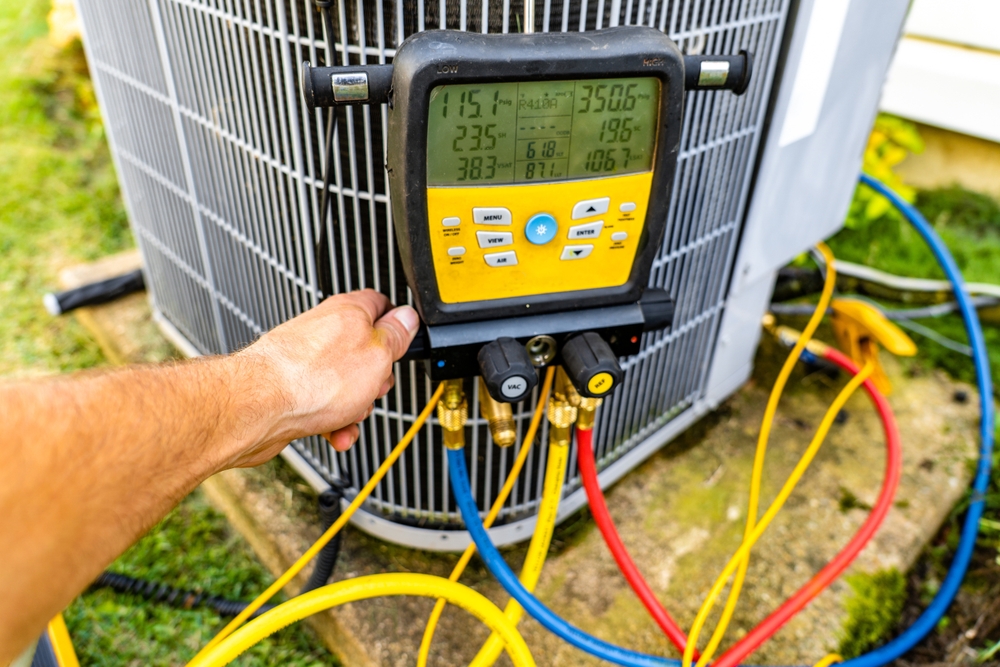
- Properly Recharge the System: Only after the leak has been repaired should the system be recharged with the correct type and amount of refrigerant. The technician will charge the system based on the manufacturer’s specifications, using precise measurements of pressure and temperature to ensure optimal performance.
The Dangers of a DIY Refrigerant Recharge
If your AC isn’t cooling, you might be tempted by DIY refrigerant recharge kits available online or in some stores. We cannot stress this enough: do not attempt to handle or add refrigerant yourself. Refrigerant is a chemical that can cause serious injury. Contact with liquid refrigerant can cause frostbite on the skin and eyes, and inhaling it can lead to dizziness, heart palpitations, and even asphyxiation in a confined space.
Additionally, using the wrong amount of refrigerant can severely damage your AC’s most expensive component, the compressor. This could force you to invest in a premature air conditioning replacement.
Finally, it’s important to note that releasing refrigerant into the atmosphere is harmful to the environment. Trained Technicians are trained and certified in the proper handling and recovery of refrigerants to prevent their release.
Get the Right Solution to Your AC Problems With Curtis Total Service
If your air conditioner isn’t keeping your home comfortable, the first step is to get a professional diagnosis. The problem could be a refrigerant leak, or it could be something else entirely. A trained and certified technician has the tools and expertise to accurately identify the root cause of the problem.
At Curtis Total Service, our technicians will never simply top off your system and call it a day. We believe in providing real, long-term solutions. We will thoroughly inspect your entire system, pinpoint the exact cause of the issue, and explain your options clearly. Whether you need a simple AC repair, a component replacement, or guidance on when it’s time for a new, high-efficiency system, we are here to help you make the best decision for your home, your comfort, and your budget.
Speak with the trusted professionals at Curtis Total Service about an inspection, and we’ll get to the bottom of why your air conditioning system isn’t cooling.